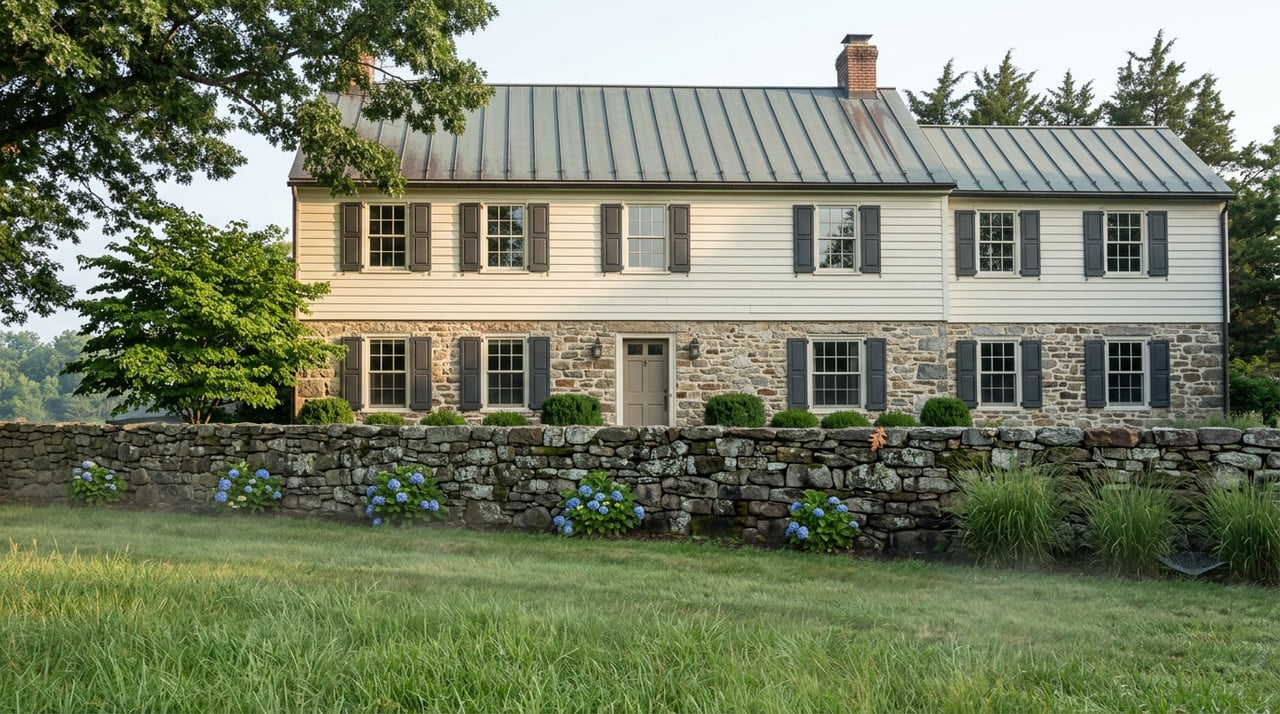
A buyer touring a stone farmhouse outside Upperville this spring found what the listing promised: rolling acreage, a clear view toward the Blue Ridge, and a price that made sense once she saw the lot size. But a large share of that acreage was under a conservation easement recorded years before.
That detail is not a footnote. It is close to the whole story of why Upperville real estate behaves the way it does, and why a buyer comparing it to a typical Loudoun or Fauquier subdivision is comparing two different kinds of markets. The land here was never left to supply and demand in the ordinary sense. Decades of deliberate policy decided how much of it could ever become more homes.
Different Snapshots of Upperville's Listing Market
Pull four real estate data feeds for Upperville in June 2026 and you will get four different market snapshots. As of June 2026, one national portal showed six active Upperville listings with a median list price near $2.62 million. Another local tracker, working from the same MLS data around June 15, 2026, counted four listings with a median list price of about $1.77 million and an average of 120 days on market. A third feed, pulling from a broader regional MLS in early June 2026, showed eight listings averaging $3.86 million, while a fourth showed six listings averaging $4.69 million.
None of these numbers are wrong. They are all snapshots of a market so thin that a handful of listings can swing the median by millions depending on which week you check and which two or three properties happen to be active.
| Snapshot (June 2026) | Active listings | Reported price |
|---|---|---|
| National portal | 6 | $2.62M median list |
| Regional MLS tracker | 4 | $1.77M median list, 120 avg. days on market |
| Broker feed A | 8 | $3.86M average |
| Broker feed B | 6 | $4.69M average |
That spread in reported prices reflects a thin market, but the deeper supply story is structural: supply was capped a long time ago.
Why the Supply Was Never Going to Grow
The reason traces back to conservation easements. The Piedmont Environmental Council has focused its easement work specifically in Fauquier and Loudoun counties, including the area around Upperville. Fauquier County's own planning department notes that PEC has helped landowners permanently protect more than 430,000 acres of rural land across the Piedmont. The Land Trust of Virginia has separately protected more than 26,000 acres statewide as of 2021, including 44 easements in Fauquier County covering just over 5,000 acres. The Virginia Outdoors Foundation, the state agency created in 1966 for exactly this purpose, holds easements on more than 850,000 acres across the Commonwealth.
A conservation easement does not just limit what an owner can build today. That is the mechanism behind the listing counts above. Upperville's inventory isn't scarce because nobody wants to sell. It's scarce because so much of the surrounding acreage has been shaped by conservation easements.
The Tax Credit That Pays Landowners to Shrink Their Own Property Value
Here is the part that looks backward until you see the incentive. The Piedmont Environmental Council says Virginia's Land Preservation Tax Credit gives a landowner who donates a conservation easement a credit worth 40 percent of the easement's value, and that value is defined as the difference between what the land was worth before the easement and what it's worth after. Run the arithmetic on a $500,000 property that drops to $300,000 in value once development rights are stripped away: the easement itself is worth $200,000, and 40 percent of that is an $80,000 tax credit the landowner can use against Virginia income tax, or sell to another taxpayer for cash.
Each individual can only apply $20,000 of credit per year against their own taxes, and landowners who don't need the full credit can sell the rest, typically netting somewhere around 80 cents on the dollar after fees. The state caps total credits issued at $75 million a year, which tells you this isn't a niche program. It's a standing financial incentive that has been steering large landowners toward permanently reducing their own subdivision potential for over two decades.
For a buyer, the practical upshot is this: the low inventory and high per-acre pricing in Upperville are not simply the product of a desirable address. They are the visible result of a tax policy.
A Second Force Now Reaching Toward the Same Fields
The same rural quality that easements protect is now the target of a different kind of pressure, and it showed up in Upperville itself. In October 2024, as the Prince William Times reported, the Piedmont Environmental Council held a meeting at Buchanan Hall in Upperville that drew 170 residents, unveiling a map of proposed high-voltage transmission routes that regional grid operator PJM was evaluating to move power toward Northern Virginia's data centers. One mapped route ran along U.S. 50 through Upperville, Middleburg, and Aldie. Hans Wachmeister, who owns Belmont Hill Farm nearby, put the stakes plainly: "Our views are incredible."
That specific route did not make PJM's short list, but the broader pressure has not gone away. Dominion Energy's Morrisville-Wishing Star project, a proposed 500 kV and 230 kV transmission line beginning south of Bealeton in Fauquier County and running roughly 18 miles through the county, held public meetings in the spring of 2025. Dominion said at the time that it hoped to reach the State Corporation Commission for a decision by that summer; under the timetable it outlined then, construction could start in 2027 if approved. Separately, the Piedmont Environmental Council has flagged a proposed 115-mile, 765 kV line called Joshua Falls-Yeat that would run from Campbell County to a new substation in Culpeper County, with PEC noting the utilities anticipate extending that connection further into Fauquier County to reach data centers in Northern Virginia. In October 2025, the Fauquier County Board of Supervisors passed a resolution supporting underground transmission construction over above-ground towers, a direct response to the scale of proposals now moving through the county.
The tension is straightforward. Conservation easements protect open land by removing the right to develop it. Transmission infrastructure doesn't need to subdivide land to change what it's worth, it only needs to cross it. A 200-foot cleared corridor and a line of steel towers can sit on top of a permanently eased farm without violating a single term of the easement, and can still change what a buyer is willing to pay for the view the easement was written to protect.
The Diligence List This Market Actually Requires
For a buyer evaluating land near Upperville, this changes what due diligence should look like.
- Ask whether the parcel, or adjoining parcels, carry a recorded conservation easement, and what it does and does not restrict. Easement deeds are recorded at the county courthouse, in Fauquier County's case the Circuit Court Records Room at the county courthouse in Warrenton.
- Ask your agent or appraiser to confirm how the easement was factored into any comparable sales being used to justify a listing price. An eased 300-acre farm and an un-eased 300-acre farm are not the same asset, even if they look identical from the road.
- Check whether the property sits near any of the transmission corridors currently under review by PJM, Dominion, or the proposed Joshua Falls-Yeat project. The Piedmont Environmental Council maintains public updates on these proposals as they move through county and state review.
- Expect a longer search than a typical Loudoun subdivision. With four to eight listings active at any given time, and average days on market running into the triple digits on at least one recent tracker, patience is part of the strategy, not a sign something is wrong.
None of this changes what draws people to Upperville in the first place. The Upperville Colt & Horse Show marked its 173rd year this past June 1 through 7, filling the fields at Grafton Farm, which earned a spot on the National Register of Historic Places in 2022. Trinity Episcopal Church's Hunt Country Stable Tour still raises more than $100,000 a year for local outreach. What has changed is how much a buyer needs to understand about why the land costs what it does, and what could reshape that cost before the next generation of owners takes title.
Frequently Asked Questions
Does a conservation easement mean nothing can ever be built on the property? The specific terms vary by easement and are worth reviewing line by line before writing an offer.
How would I know if a transmission line is proposed near a property I'm considering? Ask directly, and check the Piedmont Environmental Council's public updates on regional transmission proposals, since routes are still being narrowed by PJM, Dominion, and other utilities as of 2026. A property not near a current proposal today isn't guaranteed to stay that way as the region's power demand keeps growing.
Land near Upperville rewards buyers who understand what is actually protecting its value and what might be pressing against it. If you are weighing a purchase in this market, or trying to make sense of what a specific parcel's easement history means for its price, Gwak Homes can walk through the deed history, the comparable sales that actually apply, and the current infrastructure proposals worth watching before you make an offer. Get your free home valuation and consultation to start with the full picture.
This article is general information, not legal, tax or financial advice. Consult a qualified professional about your situation.